Excavation and Land Clearing in Whitleyville: What to Expect From Site Prep to Finished Grade
If you are standing on a wooded lot in Whitleyville or anywhere in Jackson County wondering where to start, the answer almost always begins with clearing — not digging. Clay-heavy and rocky subsoil common to the Upper Cumberland Plateau fringe means a dozer or excavator pushed into uncleared ground will fight roots, stumps, and buried rock all at once, adding time and wear to every phase that follows. Getting the sequence right from the start is what separates a smooth site prep from a costly, drawn-out one.
Do You Need Excavation AND Land Clearing, or Just One?
Most rural Whitleyville properties need both services, but they serve different roles and happen in order — clearing first, earthmoving second.
A land clearing crew removes surface growth: trees, brush, understory, and fence rows. An excavating contractor then shapes the earth underneath for a specific purpose — a building pad, a driveway cut, a level pasture. Skipping clearing before grading forces equipment to work around obstacles, which slows progress and risks damage. On the other hand, clearing a lot without a grading plan means you may bury stumps or push material into areas that will need to be re-dug. The two services are distinct, but they are designed to flow into each other.
Whether you need both depends on your lot's current condition and intended end use. A mostly open field being converted to pasture may need only light brush clearing and a finish grade. A wooded 10-acre build site in Jackson County almost certainly needs the full sequence.
How the Full Site-Prep Sequence Works
Effective site prep follows a clear order: assess the land, clear the surface, remove stumps, rough-grade for purpose, then finish to the final slope and drainage pattern.
Site Assessment: Before any equipment arrives, a contractor walks the property to evaluate slope, soil type, drainage paths, tree density, and where access will come from. On rural Jackson County lots — many of which sit off unpaved roads — the driveway cut is often part of the same project scope. The intended end use drives every decision that follows. A house pad requires precise compacted fill; a driveway needs a consistent crown and proper base; a pasture needs drainage slope to prevent standing water.
Land Clearing: Trees, brush, and understory are removed first. For heavily wooded rural acreage, forestry mulching is often the most practical method — a mulching head grinds trees and brush in place, turning material into a ground layer rather than a burn pile. This protects topsoil, eliminates the ash and erosion risk of burning, and leaves the ground ready for the next phase. You can learn more about the full scope of this phase on the land clearing service page.
Stump Removal: Stumps left in the ground create voids as they decay and can cause settling under a slab, driveway, or compacted fill area. For build sites, full extraction is typically the right call. For pastures or areas that will only see light surface use, grinding to below grade may be sufficient. Either way, stump removal must happen before grading begins — not after.
Rough Excavation and Earthmoving: With the surface clear, an excavator or dozer can work the subsoil. In Jackson County, this often means dealing with clay that holds water after rain and rocky layers that require extra passes or ripping. Cut-and-fill work — moving earth from high spots to low spots — shapes the site to the grade plan. Driveway cuts, building pad elevations, and drainage swales are all established in this phase. See the full range of excavation services for what this phase covers.
What Does 'Finished Grade' Actually Mean for a Rural Property?
Finished grade is not simply 'flat.' It means the surface has the correct slope, compaction, and drainage pattern for its intended use — and that every load of fill is stable enough to build or park on.
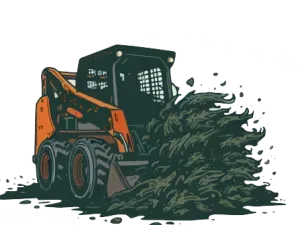
A house pad needs positive drainage sloping away from the foundation footprint, compacted in lifts so it does not settle under the slab. A gravel driveway needs a slight crown so rain sheds to the sides rather than pooling in the center. A pasture needs enough cross-slope to move water toward a natural drainage path rather than letting it sit and soften the ground. Detail work — smoothing, final shaping, and cleanup — is often done with a skid steer, which can reach tight spots a full-size machine cannot. The skid steer services used in this phase make a real difference in how clean and precise the final surface looks.
Timing Your Project Around Jackson County Conditions
Spring in this region brings wet soil that is difficult to compact and easy to rut, which can set a grading project back by weeks if rain hits at the wrong time. Summer and fall are typically the best windows for site prep on rural Whitleyville acreage — drier ground holds its shape better and compacts more reliably.
Timeline varies widely by scope. A small house pad on a lot that is already mostly clear can often be finished in one to two days. A multi-acre wooded property requiring full clearing, stump removal, and grading typically takes one to two weeks, sometimes more if rock is encountered or if seasonal rain interrupts the schedule. Honest timeline estimates depend on a site visit — slope, tree density, and soil conditions all shift the math.
Working with one contractor through the entire sequence means one mobilization, one site plan, and no scheduling gap between the crew pulling stumps and the crew setting grade. When something unexpected comes up — and on Jackson County terrain, it often does — there is no hand-off or blame shift between separate companies.
A well-executed site prep sets the foundation for everything that follows, from the first footing pour to the first truckload of gravel on the drive. Schedule your site assessment with Handy Land Worx and get a clear picture of what your Whitleyville property needs before work begins.